
Profit Margin Calculator
Calculate profit, profit margin, and markup instantly from your cost and revenue.
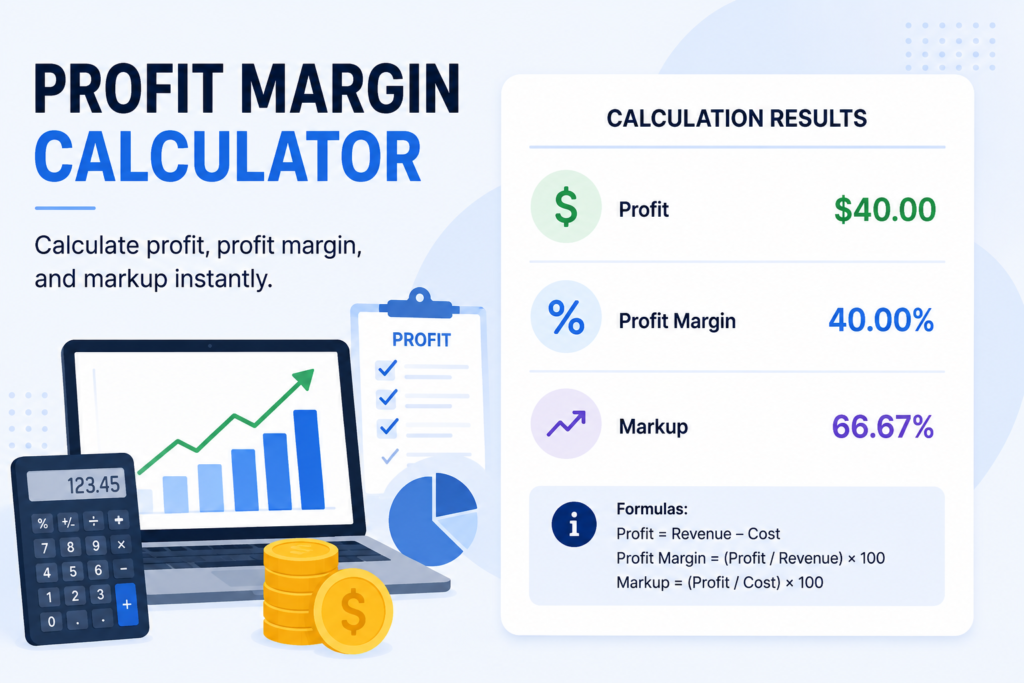
How to Use the Profit Margin Calculator
Enter revenue and cost to estimate profit and profit margin percentage.
Practical Example
If revenue is USD 1,000 and total cost is USD 700, profit is USD 300 and the profit margin is 30%.
Factors That Affect the Result
Margin depends on which costs are included. Taxes, shipping, overhead, discounts, returns and financing costs can change actual profitability.
Frequently Asked Questions
How is profit margin calculated?
Subtract cost from revenue, divide profit by revenue and multiply by 100.
Is margin the same as markup?
No. Margin is based on revenue, while markup is based on cost.
Can profit margin be negative?
Yes. A negative margin means costs exceed revenue.
Related Tools
How Profit Margin Is Calculated
Profit margin shows what percentage of sales remains after the costs included in the calculation. For a basic gross-style calculation, profit equals selling price minus cost, and margin equals profit divided by selling price × 100. A product that sells for 100 with a cost of 70 produces 30 of profit and a 30% margin.
Margin Is Not the Same as Markup
Markup divides profit by cost instead of selling price. Using the same example, the markup is about 42.86% even though the margin is 30%. Confusing these percentages can lead to incorrect pricing decisions.
Using the Result in Practice
Decide which costs belong in your analysis. Product cost alone gives a different picture from a calculation that includes shipping, payment fees, advertising, labor, returns, taxes, and overhead. A healthy margin also varies by business model and industry, so the calculator should be used as a measurement tool rather than a universal profitability target. For planning, test multiple selling prices and cost assumptions to see how changes affect both absolute profit and percentage margin.
Margin vs. Markup
Profit margin divides profit by revenue, while markup divides profit by cost. They are not interchangeable. A product bought for 80 and sold for 100 has a 20% margin but a 25% markup.
What the Margin Does Not Show
A simple product margin may exclude overhead, payroll, shipping, transaction fees, returns and taxes. Decide which costs belong in your calculation before comparing margins across products or periods.