
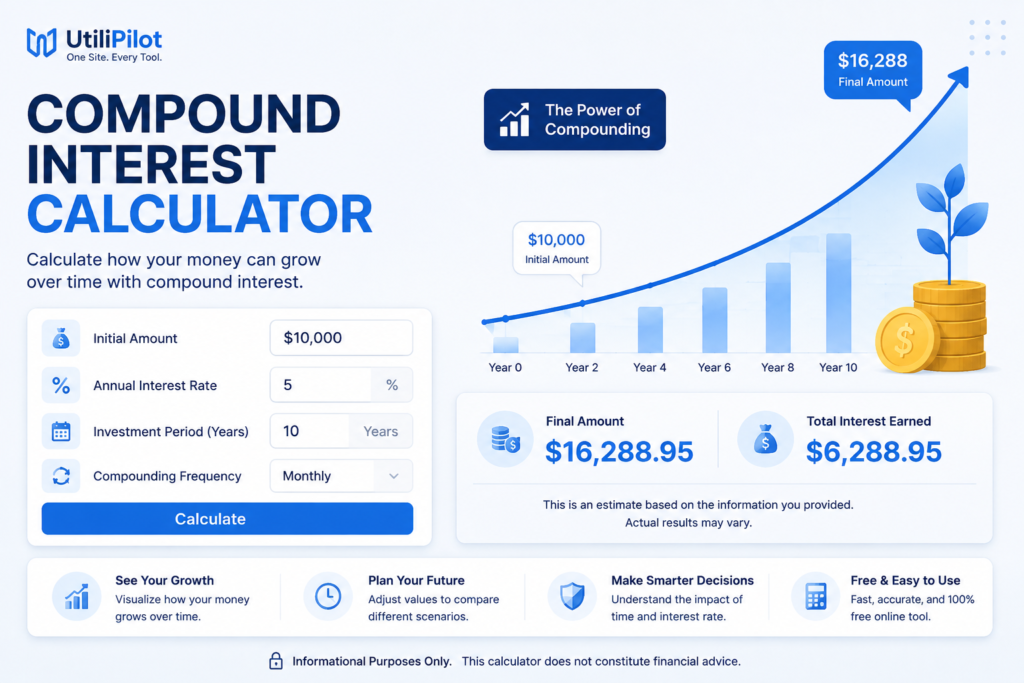
How to Use the Compound Interest Calculator
Enter the starting balance, interest rate, time period and contribution assumptions to estimate future value with compounding.
Practical Example
USD 10,000 growing at 6% annually for 10 years becomes about USD 17,908 before taxes or fees if no additional deposits are made.
Factors That Affect the Result
Compounding frequency, contribution timing, variable returns, fees, taxes and withdrawals can materially change actual growth.
Frequently Asked Questions
What is compound interest?
It is interest earned on both principal and previously accumulated interest.
Does a higher compounding frequency increase growth?
Usually yes when the nominal rate is unchanged.
Is the projected return guaranteed?
No. It is based on the rate you enter.
Related Tools
- Simple Interest Calculator
- Savings Calculator
- Future Value Calculator
- Investment Fee Calculator
- Retirement Calculator
Why Compound Interest Grows Differently
Compound interest applies growth not only to the original principal but also to interest accumulated in earlier periods. A common formula is A = P(1 + r/n)^(nt), where P is principal, r is the annual rate, n is the number of compounding periods per year, and t is time in years.
Frequency and Contributions
More frequent compounding can slightly increase the final value when the nominal rate is unchanged. Regular deposits can have an even larger effect because each contribution has its own time to grow. Conversely, fees, taxes, withdrawals, and changing rates can reduce the result.
The calculator illustrates mathematical growth from the assumptions entered. Investment returns are not guaranteed, and savings products may use different rate conventions. For realistic planning, test several rates and time horizons rather than relying on a single optimistic scenario, and distinguish nominal rates from effective annual yield when comparing products.
The Compound Interest Formula
For a single principal with no additional contributions, compound growth can be expressed as A = P(1 + r/n)^(nt), where P is principal, r is the annual rate, n is the number of compounding periods per year and t is time in years.
Compounding Frequency and Contributions
More frequent compounding can increase the ending balance when the nominal rate is unchanged. Regular contributions can have an even larger effect over long periods because each contribution has its own time to compound.
Nominal Returns vs. Real Outcomes
Calculator projections usually assume a constant rate. Actual investment or savings returns can vary, and taxes, fees, inflation and changing rates can materially affect the amount ultimately available.